

Advertisement
Become Future-Proof
The interconnection of muscles, time, and your future self

Fact-Checked
This article has been written and fact-checked by experts in the field.
You may have heard the phrase “with age comes decline.” What if, instead, each repetition of a resistance exercise is a conversation you’re having with your future self? The you who still carries a proud frame, jacks groceries up the stairs without huffing, laughs unrestrained at some ridiculous joke, and says “yes” to adventures rather than “nah, everything hurts.” Engaging your muscles in any form is that conversation. It’s also an act of open-faced rebellion against the societal expectation that aging equals sliding into frailty, slowing down, and bowing to gravity.
Do it now, benefit later
Pick two days per week to engage in full-body resistance work (like the five exercises here). Your future self will thank you, loudly!
Advertisement
We’re not going to take it
Your future self doesn’t need to send you time-travelling hate mail saying, “thanks for nothing.” When you squat and sweat, push and puff, or even choose the challenging stairs over the easy escalator, you’re flipping off Father Time: “not on my watch, you rascal.” More importantly, you’re telling yourself: “I matter. My body matters. I’m keeping the conversation alive.”
For healthy aging, older adults should engage in individualized, moderate-intensity exercise programs that combine daily endurance, resistance, and mindfulness-based practices to enhance physical, cognitive, and psychosomatic well-being; if you do, studies illustrate you can prevent and even reverse frailty and muscle loss, which account for about 70 percent of age-related physical decline.
Below are five resistance-training exercises, each using everyday items or body weight, to help you build strength in a way that’s accessible, sustainable, and fun. Complete the following circuit three times, performing 12 reps of each exercise:
Advertisement
Towel Tug-of-War Row
Target: Latissimus dorsi, rhomboids, trapezius, and core
How to do it:
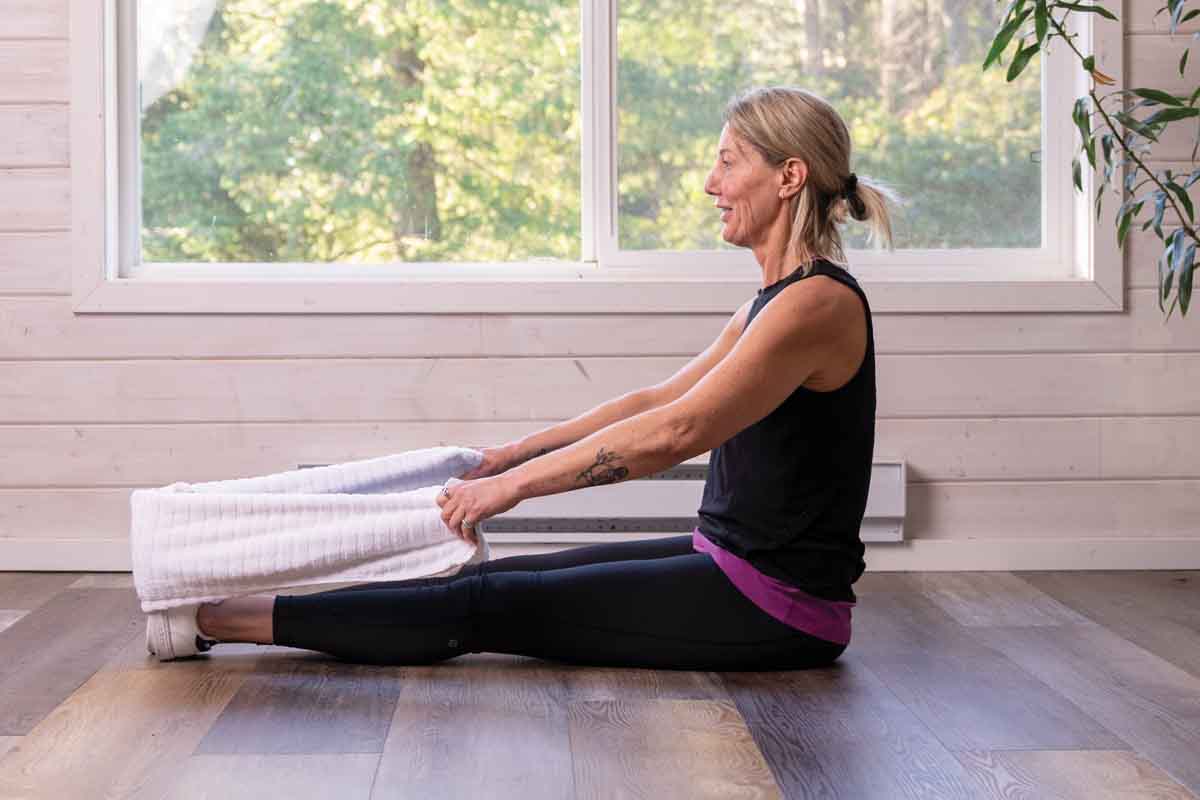
- Grab a long, sturdy towel (bath or beach towel works best). Sit on the floor with legs straight and loop the towel around your feet.
- Hold one end of the towel in each hand, shoulder-width apart. Sit upright until there’s no slack. Slightly hinge at the hips, keeping your spine neutral and core braced.
- Pull outward on the towel, as if trying to stretch it sideways, to engage your upper back before you even move.
- Without losing that outward tension, pull the towel toward your hips, driving elbows straight back and squeezing your shoulder blades together like you’re cracking a walnut for 3 seconds.
- Extend your arms forward with control, maintaining constant outward tension. Think smooth, deliberate tug-of-war.
Advertisement
Furniture Deadlift
Target: Gluteal muscles, hamstrings, and lower back
How to do it:
- Start with a small piece of furniture and work your way up.
- Grasp the bottom of the furniture with your hands, keeping your arms straight and keeping the furniture as close to your body as possible.
- Drop your butt as low to the ground as you can, while maintaining a flat back (like you are a princess sitting on a throne).
- Drive through your heels, extend hips, and stand tall, squeezing your glutes at the top. Lower back down with control.
Advertisement
Chair Push-Up
Target: Pectoralis, triceps, shoulders, and core
How to do it:
- Take a stable chair (without wheels) and place it against a wall for safety.
- Place your hands on the seat edge, shoulder-width apart. Walk your feet back until your body is at a 45-degree incline.
- Keep your body in one straight plank line, being conscious not to sag (hips drooping forward) or pike (butt in the air).
- Lower your chest toward the chair seat until elbows are at 90 degrees, then push back up.
- If that’s too easy, use a lower surface (e.g., coffee table) or go full floor.
Advertisement
Bulgarian Split Squat
Target: Gluteal muscles, hamstrings, and core
How to do it:
- Stand a few feet in front of a bench or other elevated surface. Extend one leg back and place the top of your foot on the elevated surface.
- Keep your front foot flat on the ground, about 2 to 3 feet in front of you. Your back leg should be slightly bent, and your core engaged for balance.
- Lower your body by bending your front knee, keeping your chest upright and your back straight. Descend until your front thigh is parallel to the ground or as low as your mobility allows.
- Push through your front heel to return to the starting position, ensuring that your back leg remains elevated throughout the movement. Repeat on other side.
Advertisement
Single-Leg Romanian Deadlift
Target: Hamstrings and gluteus-medius
How to do it:
- Stand on your right leg, left knee slightly bent. If you want, hold a light weight (e.g., a filled water bottle) in each hand.
- Keeping a soft bend in your right knee, hinge forward at the hips, extend your left leg straight behind you, lowering your torso until roughly parallel to floor (or as far as your hamstrings allow) while you descend your right hand (or bottle) toward the floor.
- Return to standing, squeezing your glutes at the top. Repeat on other side.
- Use a wall or chair for light balance support as needed. This exercise helps improve balance.
These five essential movement patterns are for exercisers at any stage of their fitness journey!
Supplementing your future
Supplements can be an easy and effective way to fill in the gaps and keep your body in tip-top shape, both now and in the future. Always check with a healthcare practitioner before starting new supplements.
Bone and joint support
- Vitamin D: Emerging evidence shows vitamin D plays a role in positive muscle function as we age.
- Calcium and magnesium: This traditional power couple for bone mineralization and neuromuscular health helps ensure stronger bones as we age.
- Collagen: A structural protein supporting connective tissues (tendons, ligaments), it can help keep your joints healthy.
Muscle and strength building
- Protein: This macronutrient is essential for to stimulatinge muscle-protein synthesis. Its interplay with resistance work amplifies gains in strength and tone.
- Omega-3 fatty -acids: These tend to reduce inflammation and support muscle repair and joint health.
- Antioxidants: Weight-lifters often overlook oxidative stress; polyphenol-rich foods (such as berries and green tea) support recovery.
This article was originally published in the March 2026 issue of alive magazine.